On the occasion of the International Day for the Elimination of Racial Discrimination, the ‘NEVER AGAIN’ Association published the ‘Brown Book’ – documentation of racist, xenophobic and homophobic crimes and acts of discrimination in Poland in the years 2020-2023.
The long-time author of the ‘Brown Book’ was the late Marcin Kornak (1968-2014), founder of the ‘NEVER AGAIN’ Association, social justice activist and poet. He was the mind behind social campaigns promoting respect and diversity. 20 March marks the ninth anniversary of his death.
The United Nations General Assembly established 21 March as the International Day for the Elimination of Racial Discrimination in 1966 to commemorate the Sharpeville massacre in South Africa. On this day in 1960, police opened fire on Black people protesting against apartheid. Sixty-nine protesters were killed and one hundred and eighty were injured. The tragic anniversary is commemorated all over the world to express opposition to racism, discrimination, and xenophobia.
 The latest edition of the ‘Brown Book’ on more than 300 pages describes cases of physical assaults on the basis of skin colour, language, or religion, as well as acts of verbal aggression. In addition, the report documents street demonstrations with slogans inciting hatred, acts of discrimination against minorities, and fascist banners displayed at football stadiums. Examples of hostility towards refugees from Ukraine can also be found therein.
– ‘In the Brown Book we paid a lot of attention to online hate speech, including the widely disseminated anti-Ukrainian conspiracy theories, disinformation, and direct abuse against Ukrainians’, said Dr. Anna Tatar, co-author of the report.
– ‘The Brown Book documents negative social attitudes towards minority groups. In this edition of the report, we have described, among other things, attacks on people of Asian origin as well as other minorities who were accused of spreading Covid-19’, said Jacek Dziegielewski from the ‘NEVER AGAIN’ Association.
Selected examples of events documented in the ‘Brown Book 2020-2023’:
SZCZECIN. In mid-March 2020, unknown perpetrators devastated a plaque with an inscription commemorating the Jewish residents of the city who were murdered during World War II in the Belzec extermination camp. Someone painted a swastika and the SS symbol on the plaque.
LUKOW. On 19 March 2020, three pupils of a local elementary school attacked a fifty-nine-year-old Vietnamese-born resident of the town. They shouted insults, including ‘She comes from China and has coronavirus’, ‘F*ck off you slut!’, and ‘Get the f*ck out of here, you whore, you f*cking Chinese woman!’ The perpetrators hurled stones and litter at her, spat in her direction, and one of them pushed her.
GDANSK. On 20 June 2020, an unidentified assailant attacked a man of Egyptian origin. He yelled at him, ‘Get out from here, you black w*ore’ and punched him in the face. He also tried to stab him with a knife.
WARSAW. On 17 February 2021, a gay couple was attacked. The assailant shouted, ‘Stop holding hands, children are watching’ at the men and stabbed one of them in the back with a knife. The injured man was hospitalized.
POZNAN. On 14 March 2021, on a tram one of the passengers made threats and racist insults towards a Guatemalan man travelling with his wife and child.
SZCZECIN. On 12 December 2021, Konfederacja (Confederation, far-right party) organised a ‘Shooting Competition named after Kyle Rittenhouse’ (Kyle Rittenhouse shot two participants of Black Lives Matter protests in the USA in 2020). The poster announcing the competition contained an image of Rittenhouse with a machine gun and a Confederate flag, a symbol of racial discrimination.
SEDZISZOW MALOPOLSKI. On 13 January 2022, a resident of the town brutally beat a homeless man. He punched him in the face twice, and when the victim fell to the ground, he kicked him unconscious in the head, causing numerous injuries. As a result of this attack, Slawomir K. died after spending several days in hospital.
BIALYSTOK. On 15 January 2022, during the demonstration of COVID-19 deniers, its participants chanted, ‘This is Poland and not Polin!’ (the word means Poland in Hebrew; for the extreme right it has become synonymous with the alleged rule of Jews over Poland).
KATOWICE. On 9 June 2022, at a bus stop and on the bus an unidentified man attacked a teenage boy from Ukraine. He threatened him and hurled xenophobic slurs at him.
LUBLIN. On 30 August 2022, three Black students were attacked by a group of several men. The attackers shouted ‘Black c*nts’ and punched them repeatedly.
WARSAW. On 24 September 2022, the streets of Warsaw witnessed the protest march under the slogan ‘Stop Ukrainization of Poland’, organised by Konfederacja Korony Polskiej (Confederation of the Polish Crown), a far-right party headed by Member of Parliament Grzegorz Braun. The participants unfurled banners ‘This is Poland and not Ukropol!’ (a conspiracy theory claiming that Poland is being overtaken by Ukrainians) and ‘Stop replacing the ethnic structure of Poland’.
LUBLIN. On 7 January 2023, two men attacked a Ukrainian woman, her 13-year-old son and her pregnant daughter. They shouted at them, ‘Ukrainian wh*res’, ‘F*ck Ukrainians’, ‘Get the hell out of Poland’. When the boy tried to call the police, they knocked him to the ground and punched him on the head. They also pushed the pregnant woman. They were charged with publicly insulting the Ukrainian citizens, making death threats, and using violence.
POZNAN. On 7 March 2023, activists of Mlodziez Wszechpolska (All-Polish Youth, a far-right organisation) disrupted a meeting with Ukrainian writer Oksana Zabuzhko. They chanted ‘Poland is for us!’ Meetings with the writer were also disrupted by members of Mlodziez Wszechpolska on 21 November 2022 in Krakow and on 14 February 2023 in Warsaw.
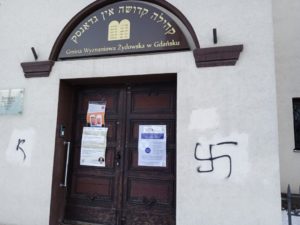
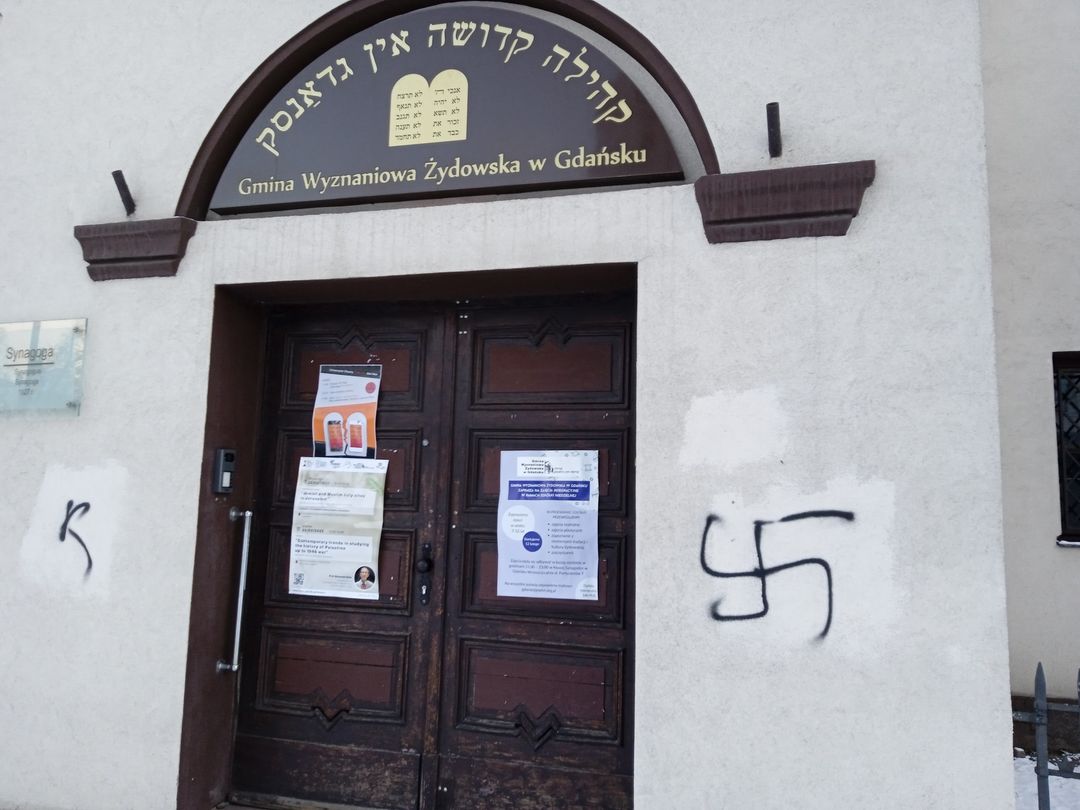
GDANSK. On the night of 11/12 March 2023, two juvenile perpetrators painted a swastika on the entrance to the synagogue in Gdansk-Wrzeszcz. Three ‘K’ letters, which stand for Ku-Klux-Klan, also appeared on the façade.
In April 2022, the ‘NEVER AGAIN’ Association published a report entitled ‘Let’s Maintain Solidarity with Refugees’ about cases of discrimination and hate speech against Ukrainians, refugees, and ethnic minorities in Poland in the context of the ongoing war. In January 2023, the ‘NEVER AGAIN’ Association published a report on hate speech as well as antisemitic and anti-Ukrainian conspiracy theories propagated on the Media Narodowe (National Media) online tv channel. After the report had been published, the channel was removed by YouTube.
The ‘NEVER AGAIN’ Association is an independent anti-racist organisation founded in Warsaw in 1996. It has monitored hate crimes and hate speech as well as campaigned against antisemitism and xenophobia, for peace, intercultural dialogue and human rights both in Poland and internationally.
From 1 March 2022 to 1 March 2023, data collection for the ‘Brown Book’ was supported by the Henryk Wujec Civic Fund. Henryk Wujec (1940-2020) was an activist of the Workers’ Defence Committee (KOR) in the 1970s, political prisoner in the 1980s, member of the International Auschwitz Council and civil society mentor.

‘Brown Book 2020-2023’ (full version of the report):
https://www.nigdywiecej.org//docstation/com_docstation/172/brown_book_2020_2023.pdf
Additional information:
www.nigdywiecej.org
www.facebook.com/Respect.Diversity
https://twitter.com/StowNIGDYWIECEJ
www.linkedin.com/company/never-again-association




 The Association has unveiled the emblem of the anti-war campaign, authored by Witold Popiel, a graduate of the Warsaw Academy of Fine Arts and inspired by the logo of ‘NEVER AGAIN’s long-term campaign ‘Music Against Racism’.
 The ‘NEVER AGAIN’ Association invites musicians, record labels and promoters who are interested in releasing music tracks or videos as well as organising concerts with the promotional support of ‘Music Against War’ to get in touch via email:

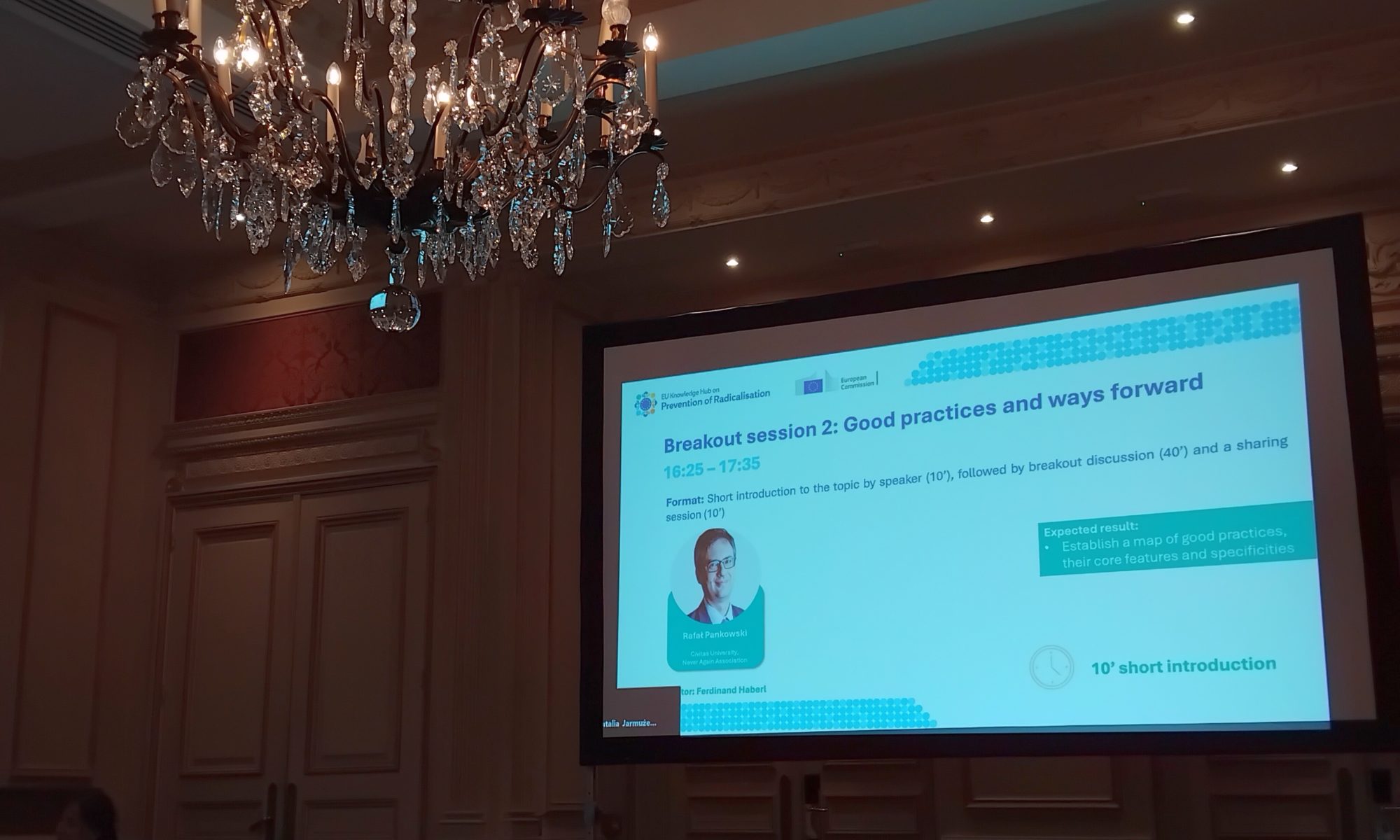
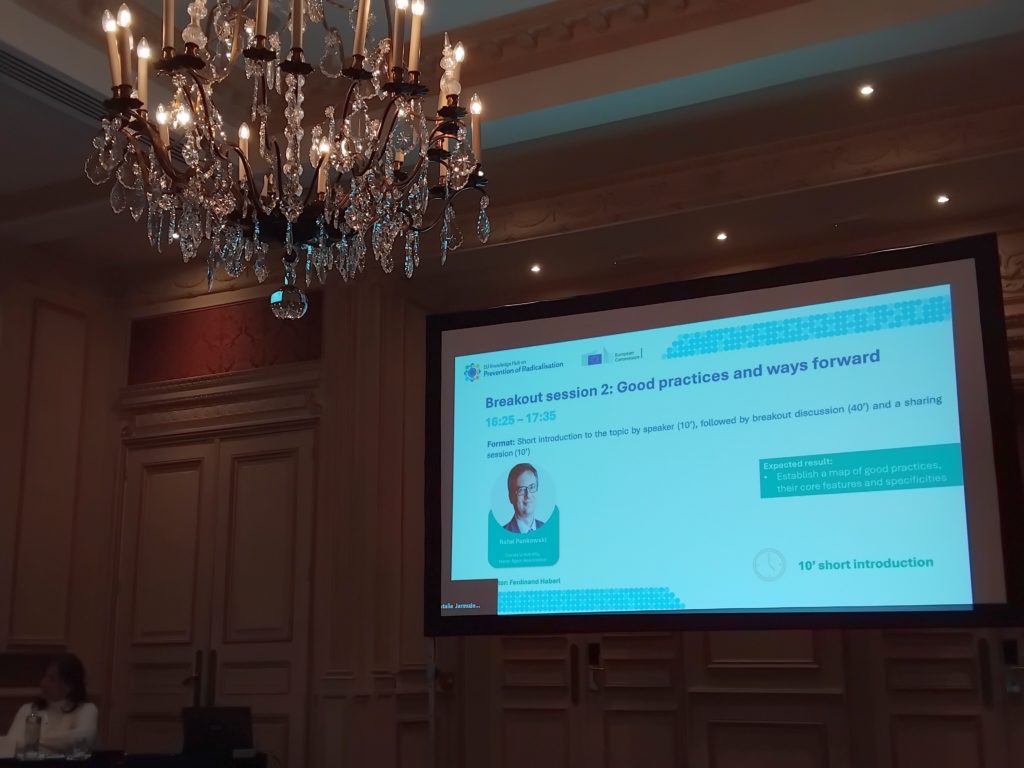
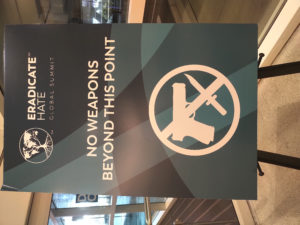 Co-founder of ‘NEVER AGAIN’ Rafal Pankowski participated in the Eradicate Hate Global Summit held in Pittsburgh, Pennsylvania (USA) on 19-21 September 2022. The Summit is the most comprehensive anti-hate conference in the world. It unites experts and leaders from around the globe, who are dedicated to eradicating all forms of hate-fuelled violence. The mission of the Summit is to identify and implement effective solutions for collective change.
 On another festival day a meeting was held with the rock band Strachy na Lachy (Empty Threats) at the information stand of the ‘NEVER AGAIN’ Association. For many years, this group has been involved in the activities of the ‘Music Against Racism’ campaign run by ‘NEVER AGAIN’. Krzysztof ‘Grabaz’ Grabowski, the leader of Strachy Na Lachy, explained his band’s involvement in support of the refugees from Ukraine after the outbreak of the war. Some of the musician’s family came from Volhynia (a previously Polish territory, now a region in Ukraine). In press interviews, ‘Grabaz’ emphasised the importance of having neighbours of different nationalities and how it can lead to outbursts of creativity: ‘If in some place different cultures coexist peacefully with each other, then they will undoubtedly develop that place and its culture’.
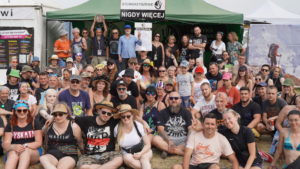 – ‘During our meeting with Strachy Na Lachy, we talked primarily about war and peace, about respect and prejudice in everyday life, about hate speech and how it can lead to violence. We asked the band to explain how music can create a better world,’ said Joanna Naranowicz, a representative of the ‘NEVER AGAIN’ Association and the lead singer of the punk band Qulturka.
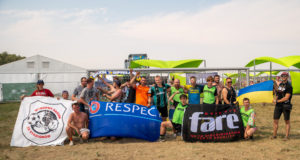
 The ‘Lets’ Kick Racism out of the Stadiums’ tournament has been organised for over twenty years by the ‘NEVER AGAIN’ Association at the Polish Woodstock/Pol’and’Rock Festival. In 2022 it was co-organized with the grass-roots football team FC GAN Pila and supported by FARE network and the Adidas Football Collective through its grassroots support programme. Tournament’s male and female participants jointly express their support for the ideas that guide the entire festival: peace, friendship and respect for diversity. This year, the message resonated particularly strongly with young players from Ukraine who had had to flee the cruelty of war.
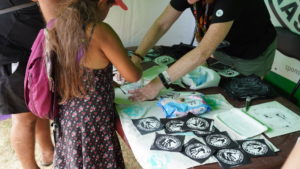 During the Pol’and’Rock Festival, the ‘NEVER AGAIN’ Association also organised educational workshops on volunteering and supporting refugees. At NEVER AGAIN’s information stand, there were also practical worskhops on designing anti-racist DIY sew-on patches and t-shirts with the use of stencils and paints. The resulting items of clothing with the message ‘Music Against Racism’ were presented to the participants!
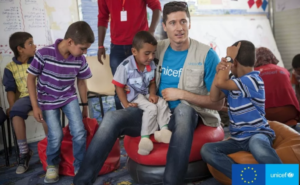 The best player in the history of Polish football and the captain of the Polish national team has been supporting for years people who had to leave their homes due to war and persecution. In May 2014, Robert Lewandowski, as the UNICEF Goodwill Ambassador, visited the Syrian refugee camp in Zaatari, Jordan. At that time, over 100,000 people were staying there, more than half of whom were children. The civil war in Syria has been going on since 2011. According to the United Nations, nearly 12,000 children were killed or injured during the war. Lewandowski, together with two boys, Hisham and Mohammad, visited the place where the children spend their free time, which helps them deal with the traumatic experiences. The footballer appealed: ‘We must be open to the children’s voice. Give them your voice, tell your relatives and friends that there are children all over the world who are waiting for our help and interest. Help us tell their story. Your voice is priceless for these children.’
 The ‘NEVER AGAIN’ Association is an independent anti-racist organization founded in Warsaw in 1996. The ‘NEVER AGAIN’ Association has conducted the first anti-racism campaign in Eastern European football, ‘Let’s Kick Racism Out of the Stadiums’ and is a founding member of the Fare network. Since 2005, it has led the ‘Racism-Delete’ campaign, which has the objective of removing antisemitic and racist content from the internet. The ‘NEVER AGAIN’ Association is a member of the International Network Against Cyber Hate (INACH) and the Global Alliance Against Digital Hate and Extremism (GADHE). The Association also takes part in projects to counteract online hate speech such as ‘Get the Trolls Out’ and ‘Open Code for Hate-Free Communication’.
 The event, entitled ‘The Urgent Need for Action Against Online Harms: Global Stories From Frontline Activists’, was held virtually. Speakers included Alliance members, researchers, and people directly harmed by online hate from Iraq, Poland, Myanmar, and the United States.